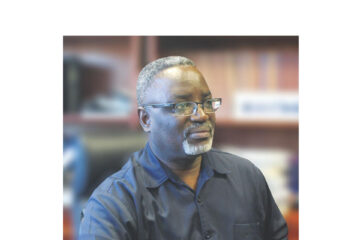
Public office is not merely a position of authority; it is a platform of influence. Every statement made by a minister carries weight beyond ordinary conversation, shaping public perception, institutional trust, and national cohesion. It is for this reason that the recent controversies surrounding Minister of Urban and Rural Development James Sankwasa deserve sober reflection, not only by the minister himself, but by all who occupy positions of leadership in Namibia’s democratic order.
The Editors Forum of Namibia (EFN) issued a strong condemnation following a personal and xenophobic attack directed at The Namibian journalist Tracy Tafirenyika. The attack reportedly arose after Tafirenyika published a report concerning alleged unpaid NamWater bills linked to the minister. According to EFN, the response targeted the journalist on the basis of nationality rather than addressing the substance of the report. The forum warned that such rhetoric undermines press freedom, distracts from accountability, and introduces xenophobic undertones that have no place in Namibia’s democratic culture.
Whether Minister Sankwasa intended to attack the journalist personally or merely reacted defensively to critical reporting is almost beside the point. What matters is that public perception has been shaped by the tone and content of the response. When a public official responds to scrutiny with personal or nationality-based remarks, the issue shifts from the question of service delivery or financial accountability to one of democratic principle: the right of the press to ask difficult questions without fear of intimidation.
Robust journalism is not an inconvenience to governance; it is a cornerstone of it. Ministers must expect scrutiny, particularly when allegations of unpaid public utility bills or service obligations arise. The appropriate response in such circumstances is transparency, factual clarification, or formal rebuttal, not personal or xenophobic insinuation. When the messenger is attacked instead of the message being addressed, confidence in public institutions is eroded.
Yet this is not the only instance in which the minister’s public remarks have drawn concern. In the Zambezi Region, the Katima Mulilo Town Council publicly objected to statements attributed to Minister Sankwasa in which he allegedly declared that “Masubia councillors must go,” and pledged to end what he described as “tribal dominance” in the Katima Mulilo Town Council and the Zambezi Regional Council. The council characterised these remarks as “tribally charged and politically motivated,” warning that such language could inflame division in a region that has long prided itself on coexistence among diverse communities.
Again, it is possible that the minister’s underlying intention was to address governance inefficiencies or political imbalance. But intentions do not erase impact. When reformist language adopts the vocabulary of ethnic removal or dominance, it inevitably evokes memories of exclusion and marginalisation, realities that Namibia’s post-independence project has worked diligently to overcome. Our national ethos is rooted in unity in diversity. Any rhetoric that appears to single out ethnic groups for political removal, even metaphorically, risks undermining that fragile social compact.
Leadership demands not only courage, but precision. A minister may rightly pursue accountability, improved governance, and service delivery. He may critique councils, challenge inefficiency, and push for reform. But he must do so in a manner that targets conduct and performance, not identity. There is a world of difference between calling for better governance and calling for the removal of councillors described by their ethnic identity. One strengthens democracy; the other weakens it.
Minister Sankwasa now finds himself at an important crossroads. His portfolio is central to the everyday lives of Namibians, water access, local governance, municipal stability, and rural development. The credibility of that office depends not only on policy decisions but on the tone of leadership. Public trust is not built through confrontation and personalisation of criticism. It is built through consistency, fairness, and restraint.
Public officials must also remember that accountability is reciprocal. Ministers hold civil servants accountable. Government holds councils accountable. The public holds leaders accountable. And the press, as the watchdog of democracy, holds all to account. To demand accountability from others while resisting scrutiny of oneself creates a credibility gap that no public relations campaign can repair.
Namibia’s democracy is still young by global standards, but it has matured remarkably in its tolerance for dissent, criticism, and open debate. That progress must not be reversed by inflammatory rhetoric, whether tribal, xenophobic, or personal. The political temperature in the country need not be raised every time disagreement arises. Measured leadership can disagree without demeaning, correct without insulting, and reform without dividing.
Words matter. They carry force. They linger long after press statements fade and news cycles move on. When uttered by those in high office, they become part of the historical record of governance. That is why leaders must choose them carefully, especially in a nation whose strength lies in its peaceful diversity.
Minister Sankwasa has an opportunity to reset the tone. He can clarify his intentions, reaffirm commitment to inclusive governance, and demonstrate respect for the role of the media in public accountability. Doing so would not be a sign of weakness, but of statesmanship. Namibia does not need leaders who shout the loudest. It needs leaders who speak wisely.
We urge Minister Sankwasa, and indeed all public officials, to tread carefully. Hold others accountable, yes. But accept that you too will be held accountable, for actions, for decisions, and for words. In public service, there are no private utterances. Every statement is a public act. And in a democracy, the weight of words can either build bridges or burn them.
Namibia deserves bridges.