Chamwe Kaira
As the 2025/26 maize marketing year approaches its close in April 2026, South Africa’s maize exports continue, but at a slower pace than expected.
Economist Wandile Sihlobo said recent trade data shows exports have not moved as quickly as anticipated.
“I was looking at South Africa’s grain trade data and thought I’d make a few remarks about the slow pace of exports based on recent trends,” Sihlobo said in his February analysis on South African maize trade.
More than two-thirds of maize exports this season have gone to countries in the Southern African region. Zimbabwe, Botswana, Namibia and Mozambique remain the main buyers.
“Zimbabwe is by far the largest buyer of South African maize, accounting for about 35% of South Africa’s maize exports between May 2025 and mid-February 2026,” he said, noting that more shipments are still expected before the season ends.
South Africa has about one million tonnes of maize left to export this season. Sihlobo expects Zimbabwe and Botswana, along with some overseas markets, to remain key destinations.
He said export volumes in recent weeks have been “modest”, raising concern as the marketing year nears its end. In the week of 13 February, South Africa exported just under 40 000 tonnes of maize. About half went to Zimbabwe and 17% to Botswana, with the rest going to other regional markets.
Total maize exports so far stand at around 1.6 million tonnes, compared to a seasonal target of 2.4 million tonnes. This points to a slower-than-expected export pace.
Sihlobo said the slow exports, together with prospects of a strong new-season crop, have pushed maize prices down by about 30% compared to a year ago. This has added pressure to local markets.
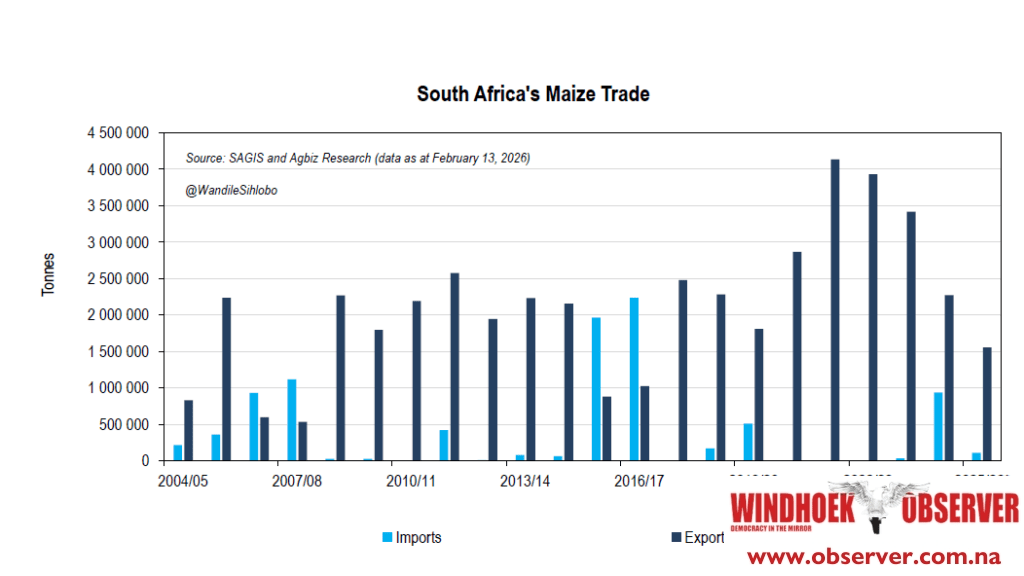
Despite the current slowdown, long-term data shows that South Africa has remained a net exporter of maize for most of the past two decades. Data from SAGIS and Agbiz Research, as at 13 February 2026, shows export volumes have generally exceeded imports since the 2004/05 marketing year.
In the mid-2000s, maize exports averaged more than 2 million tonnes per year, while imports were usually below 1 million tonnes. During drought seasons such as 2006/07 and 2007/08, imports rose above 1 million tonnes due to lower domestic production.
The 2015/16 drought caused a major disruption. Imports increased to more than 2 million tonnes as output fell. In the following 2016/17 season, improved harvests lifted exports to about 2.5 million tonnes, restoring South Africa’s net exporter position.
Between 2018/19 and 2022/23, export performance strengthened. Exports reached nearly 4 million tonnes in 2022/23, the highest level in the period under review, supported by strong harvests and regional demand. Imports during this period remained low.
In 2023/24 and 2024/25, exports declined from peak levels but remained above historical averages. For the 2025/26 marketing year, exports are forecast at about 1.5 million tonnes. Imports remain low compared to drought years, pointing to tighter but manageable domestic supplies.
The data shows that South Africa continues to play a central role as a maize supplier in the region, with trade patterns closely linked to weather conditions and production levels.