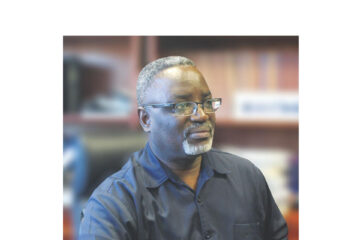
Paul T. Shipale (with inputs by Folito Nghitongovali Diawara Gaspar)
In the aftermath of President Netumbo Nandi-Ndaitwah’s state of the nation address (Sona), public debate has largely fixated on tone, style, delivery, and symbolism.
This is a familiar distraction. The real issue is structural. What kind of state is Namibia becoming, and whether it advances or defers the unfinished project of liberation.
At stake is not simply policy direction but the deeper question that has defined post-colonial Africa; can political sovereignty evolve into economic control, or will it remain structurally constrained?
Continuity without transformation
At a rhetorical level, the Sona is firmly anchored in the ideological lineage of the founding father H.E. Dr Sam Nujoma, whom the President acknowledged and made reference to at the beginning of her speech. The familiar pillars of sovereignty, development, social justice and national unity remain intact. Liberation memory is invoked not as nostalgia but as a source of legitimacy.
But continuity should not be mistaken for replication.
For the founding generation, economic independence was a structural project and a deliberate reordering of ownership, production, and control. It was not simply about growth but about who directs accumulation.
What emerges in this Sona is more restrained. Namibia is no longer attempting to fundamentally restructure its insertion into the global economy; it is attempting to optimise its position within it.
This is not a semantic shift. It is a strategic pivot.
One approach is about power. The other is about efficiency within constraint.
The architecture of managed integration
The macroeconomic indicators presented are credible:
• repayment of a N$14.3 billion eurobond,
• foreign reserves at N$51.9 billion,
• projected GDP growth of 3.1%,
• over N$63.5 billion in investment commitments,
• expanded financial inclusion and improved fiscal administration.
These are not cosmetic gains. They signal a functioning macroeconomic framework, something many states struggle to sustain.
But stability is not transformation.
Growth remains anchored in:
• extractive industries (oil, gas, uranium, mining),
• capital-intensive megaprojects,
• and partnerships heavily reliant on foreign capital.
Even the language of transformation value addition, industrial policy, sovereign wealth funds is framed within this same logic.
Namibia is not restructuring the terms of its integration into the global economy. It is negotiating a better position within it.
Across the Global South, this model has produced a familiar equilibrium of growth without control and stability without structural change.
Namibia is not breaking from this pattern. It is refining it and betting it can manage its contradictions.
Energy wealth opportunity or repetition
Nowhere is this gamble more consequential than in the energy sector.
Namibia stands on the threshold of potentially transformative oil, gas, and green hydrogen developments. The President’s warning about the “resource curse”, alongside references to Norway and other countries such as Angola and Guyana, signals awareness.
But awareness is not strategy.
The central question remains unanswered:
• Who owns the assets?
• Who controls the value chain?
• Who accumulates the surplus?
Absent enforceable local content regimes, meaningful state participation, and deliberate industrial linkages, the outcome is predictable and value will be captured upstream by foreign capital, while domestic participation remains confined to wages, services, and taxation.
Norway imposed control early, backed by state capacity and strategic clarity. Angola illustrates the opposite: resource wealth without broad-based transformation.
Namibia stands between these paths, but it cannot occupy both indefinitely. And the longer control is deferred, the harder it becomes to assert.
Inclusion without transformation
The SONA outlines an expansive social agenda:
• reducing food imports,
• expanding agriculture,
• financing youth enterprises,
• registering over 130,000 jobs,
• subsidising tertiary education,
• investing in vocational and STEM training.
These are meaningful interventions. They address real pressures and contribute to social stability.
But they reveal a deeper contradiction: that redistribution is being pursued without restructuring production.
The state is attempting to correct outcomes that the underlying economic model continues to reproduce.
This reflects a classic dual economy of a capital-intensive enclave integrated into global markets and alongside a large, low-productivity domestic sector.
Youth programs, SME financing, and education expansion are necessary but historically insufficient when ownership and capital formation remain concentrated.
In this framework, inclusion risks becoming compensatory rather than transformative.
The politics of slogans
It is within this contradiction that political messaging becomes revealing.
“We are too few to be poor.”
It is a powerful phrase, morally compelling and politically resonant. But slogans do not alter economic structures.
If anything, they risk obscuring them.
Because poverty is not a function of population size. It is a function of how an economy is organised, who owns assets, who controls production, and how value is distributed.
In this sense, the slogan performs a subtle political function; it reframes a structural problem as a moral paradox.
The risk is not the slogan itself, but its use:
• as aspiration without mechanism,
• as unity masking inequality,
• as mobilisation without structural change.
When the majority remains excluded from ownership and accumulation, such language becomes less a promise than a deferral.
Capacity: The decisive variable state
Everything in this strategy resource governance, industrial policy, local content enforcement depends on one factor: the state.
There are signs of progress:
• procurement reforms,
• digitalisation,
• expanded service delivery.
But the constraints are equally clear:
• implementation bottlenecks,
• limited technical capacity,
• institutional fragility.
This is not a secondary issue; it is foundational.
Because managed integration only works under specific conditions:
• the state must negotiate effectively with global capital,
• enforce regulatory frameworks,
• coordinate industrial policy,
• and resist rent-seeking.
Without this, policy becomes aspirational and growth becomes extractive rather than developmental.
Namibia’s constraint is not primarily capital. It is administrative power.
Stability as Strategy and Its Limits
The governing philosophy is clear: stability first, transformation gradually.
This is reflected in:
• cautious fiscal management,
• incremental reform,
• avoidance of disruptive redistribution,
• emphasis on investor confidence.
It aligns Namibia with gradualist models such as Botswana.
It is also a wager.
A wager that:
• growth will eventually diffuse,
• inequality will not harden,
• and time will remain available for correction.
History suggests otherwise.
Gradualism often stabilises the present while entrenching its inequalities. Capital consolidates. Ownership hardens. And the political cost of transformation rises over time.
The Unresolved Question
What emerges from the SONA is neither rupture nor stagnation. It is a managed transition of a state navigating between its liberation legacy and the constraints of a globalised economy.
But one question remains unresolved: who will own Namibia’s future?
If control over key sectors remains external, then independence will remain incomplete, politically secured, and economically deferred.
If, however, Namibia converts its resource endowment into domestic industrial, technological, and institutional capacity, this moment may yet mark a turning point.
Conclusion: Growth or ownership
The President has chosen pragmatism over rupture. Stability over risk. Evolution over overhaul.
This is not a failure of vision. It is a recognition of constraint.
But pragmatism is not neutral. It distributes power. It shapes outcomes. It determines who benefits and who waits.
In the end, the question is not whether Namibia will grow. It is whether Namibia will own its growth.
Because history offers a consistent warning that nations that do not transform their economic structures do not eliminate poverty, they only manage it.
And those who are “too few to be poor” can, for generations, remain just numerous enough to be governed by that promise.
Disclaimer: The opinions expressed here do not necessarily reflect those of our employers or this newspaper. They represent our personal views as citizens and pan-Africanists.