
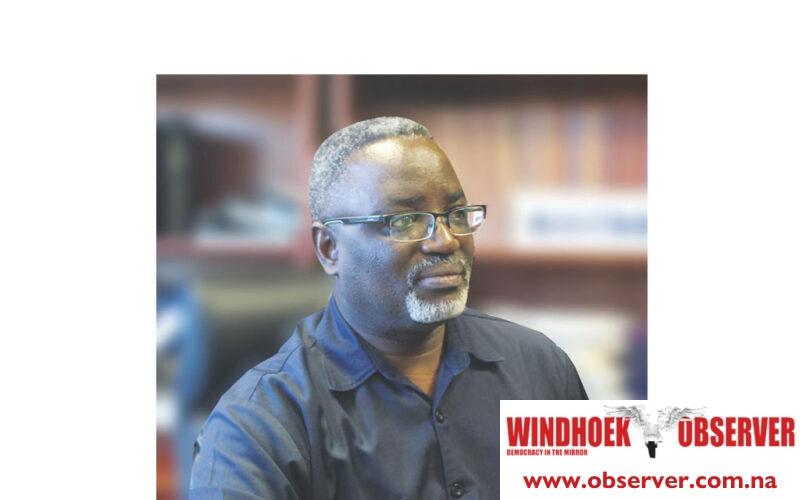
Paul T. Shipale (with inputs by Folito Nghitongovali Diawara Gaspar)
Listening to the tributes and messages of condolences on the occasion of the memorial service at Parliament Gardens in honour of the late Hon. James Unomasa Uerikua and his beloved son Venturo, one thing that struck a chord so profoundly was the fact that most of the leaders of the opposition parties are young and were once upon a time either in the Nanso, workers’ union, youth league and Swapo party leadership, and one wonders why so. Perhaps the answer lies in their message that seeks to redefine freedom based on economic transformation instead of independence, peace and stability alone. Indeed, in a country of just three million people, endowed with vast natural resources and long praised for its political stability, the present outcome is difficult to justify. In Namibia, wealth and absence coexist in plain sight with gated suburbs alongside expanding informal settlements, institutional order alongside quiet disillusionment.
At independence, Founding Father H.E. Dr Sam Nujoma, may his soul continue to rest in peace and may his undying and resilient spirit continue to guide us and illuminate our path in the struggle for economic freedom in the spirit of unity as One Namibia, One Nation, did not envision a nation that would merely endure. The struggle was not waged for stability alone, but for dignity, equity, and economic emancipation. Political sovereignty was meant to reorder not just power, but opportunity itself.
Three decades later, the central question is no longer whether Namibia is stable. It is whether that stability has been used to build a nation or to manage its stagnation.
The logic of drift
Namibia’s challenge is not collapse. It is drift. The country’s institutions function. Elections are held. The state operates without visible crisis. Yet beneath this surface, a quieter process has unfolded: that of the gradual erosion of trust, the normalisation of inequality, and the widening gap between formal structures and lived realities.
But this drift is not purely domestic. It reflects a broader post-colonial condition in which political sovereignty was achieved without equivalent economic sovereignty. Namibia operates within a global system where value is extracted more easily than it is accumulated locally, where external market structures continue to shape internal possibilities. In such a context, even functional institutions can preside over stagnation.
For a generation that did not live the liberation struggle, legitimacy is no longer inherited. It must be earned. And here, the deficit is growing.
Stability without mobility
Namibia’s defining paradox is not instability, but immobility. It remains one of the most unequal societies in the world, not as an abstraction but as lived geography. Opportunity is unevenly distributed, and for many young Namibians, upward mobility feels increasingly out of reach.
Youth unemployment is not merely economic; it is political. A system that cannot absorb its population into meaningful participation is not simply underperforming; it is accumulating pressure.
A system enters crisis not only when it collapses but also when it ceases to generate belief. In such environments, the state risks shifting from regulator to allocator of opportunity.
When success depends less on productivity and more on other considerations, the economy quietly reorients. Diversification slows, innovation weakens, and rents from natural resources circulate within a narrow ecosystem.
This is not dysfunction. It is a functioning system that underdelivers.
From a broader African perspective, this reflects a recurring pattern: that of the emergence of a globally integrated class of the elite alongside domestically excluded populations. Integration into international capital circuits advances, while internal economic inclusion lags behind. The result is not simply inequality, but structural misalignment where the economy connects outward more effectively than it integrates inward.
A country too small for this outcome
Namibia’s scale should be an advantage. Namibia’s population size makes inclusive development more achievable, not less. Which makes the contradiction unavoidable.
President Netumbo Nandi-Ndaitwah’s observation that Namibia is “too few to be poor” is not merely descriptive; it is diagnostic. If the country is indeed too small to justify widespread poverty, then poverty is no longer a structural inevitability. It is a political outcome.
Growth without transformation
Namibia reflects a familiar post-colonial pattern of growth without structural change. What emerges is a dual global economy integrated at the top, structurally precarious at the base.
This trajectory echoes warnings long articulated by Pan-African thinkers such as Kwame Nkrumah and Thomas Sankara that political independence without economic restructuring reproduces dependency in new forms. Growth mediated through external systems stabilises the macroeconomy while leaving the underlying hierarchy of production and ownership intact.
Growth occurs. But it does not reorganise society. The promise of independence was not growth alone. It was economic freedom and transformation.
When poverty becomes less visible
A more subtle shift has taken place. Poverty has declined in statistical terms but remains structurally embedded. As it becomes less widespread, it also becomes less visible, fragmented across rural margins, urban peripheries, and informal economies.
This produces a dangerous illusion that aggregate improvement equals systemic change. It does not. It produces what might be called statistical comfort, a sense of progress that obscures the persistence of exclusion.
The generational fault line
Two Namibias now coexist. One derives legitimacy from liberation history. The other demands legitimacy through present performance.
For the first, stability is an achievement. For the second, stability without progress is a ceiling.
This divergence is not yet explosive, but it is deepening. Stability can delay rupture. It cannot eliminate it.
Equilibrium as entrapment
The central question whether Namibia is managing itself or failing itself admits no simple binary.
Namibia is doing both. It manages itself well enough to avoid crisis while failing persistently enough to foreclose transformation. What emerges is neither collapse nor success but equilibrium, one that risks hardening into stagnation.
A system that reproduces itself without expanding opportunity does not break immediately. It settles. And for a country “too few to be poor”, settling may be the greater failure.
What happens if nothing changes?
The absence of crisis should not be mistaken for the absence of risk.
History is consistent, and systems that manage stagnation indefinitely eventually confront pressure for restructuring. The timing is uncertain. The logic is not.
The unfinished mandate of liberation
The generation of the Founding Father H.E. Dr Sam Nujoma secured sovereignty. But sovereignty was never the endpoint; it was the precondition.
The mandate was transforming an economy reflecting political freedom, not merely accompanying it. That mandate remains incomplete. And deferral, over time, becomes a decision.
The choice ahead
Namibia still possesses what many nations lack: stability, institutional continuity, and time. But these are not guarantees. They are opportunities.
The real choice is no longer between stability and instability. It is between:
• a stability that manages inequality
• and a stability that dismantles it
This requires more than incremental reform. It demands structural reorientation. But it also demands something broader. For Namibia, as for much of Africa, transformation may ultimately depend not only on internal reform but also on repositioning within the continent and the global system. Initiatives such as the African Continental Free Trade Area offer a pathway toward regional value chains, industrial coordination, and reduced external dependency but only if pursued strategically.
Final reflection: The question of will
Namibia has answered whether it can remain stable. The unresolved question is whether it is willing to become something greater than stable.
Because a nation that once fought to find its voice now faces a different test: whether it is willing to listen to those excluded not by colonial rule but by the internal architecture of its own political economy, operating within a still unequal global order.
Namibia is not collapsing. It is not in crisis. But it risks something quieter and more dangerous, that is, the normalisation of underperformance in a country capable of far more.
The next phase of its history will not be defined by the stability it preserved but by whether that stability is finally used to transform not only within its borders but also in how it positions itself within Africa and the world.
Legitimacy cannot be inherited
Liberation movements such as the MPLA in Angola, FRELIMO in Mozambique, ZANU-PF in Zimbabwe, Swapo party in Namibia and the ANC in South Africa emerged from real struggles against systems of oppression.
But that legitimacy was foundational, not perpetual. That was a vehicle and a means to an end, not the ultimate prize. Cabral insisted on a fundamental principle: “Analyse concrete reality.” Armed struggle was not dogma but a response to a specific demand under specific circumstances. The legacy of liberation does not come from criticism but from its instrumentalisation by systems that betray their founding principles.
History does not repeat itself only through imposition; it also repeats itself through a lack of political imagination.
Redefining freedom in 21st century Africa
True fidelity to the spirit of liberation is in ensuring that its objectives, dignity, justice, and real sovereignty are not permanently deferred.
If the first liberation expelled external domination, the second must confront the enemy within and a more uncomfortable truth that freedom can be proclaimed and still not be lived. One year has passed since the Founding Father of the Nation departed from us physically. One year since the clearest voice of our unity fell silent. And yet, with honesty and courage, we must ask ourselves, have we been faithful to the legacy entrusted to us?
Today we assume responsibility and say, ‘Father of the Nation, forgive us.’ Forgive us for allowing divisions to grow where unity should have prevailed. Forgive us for diluting your clear, simple, and non-negotiable message of One Namibia, One Nation.
Today, Namibia faces deep challenges: social, economic, and moral. These problems did not arise by chance. They are, in large measure, the result of our departure from our strategic vision. When we abandon unity, we make room for selfishness. When we forget reconciliation, we reopen old wounds. When we place personal, tribal, or momentary interests above the common good, we betray the sacrifice that delivered our freedom.
The Founding Father, Dr Sam Shafiishuna Nujoma, did not leave us independence alone.
He left us a path. If today we struggle, it is not because the vision failed. It is because we failed the vision.
Let it be clearly stated on this solemn occasion as we lay to rest the Hon. Uerikua, the challenges we face today have solutions. Those solutions are not found in hatred. They are not found in exclusion. They are not found in tribalism, regionalism, or social fragmentation.
The solution remains where it has always been: in the vision of the Founding Father. In national unity. In the daily choice to live as One Namibia, One Nation.
With the passing of Hon. Uerikua, we ask for silence. Silence to hear the voice of history. Silence so that each of us, in the depth of our consciences, may ask:
What have I done with the freedom entrusted to me?
Let this silence weigh heavily.
Let it unsettle us. Let it remind us that independence was not a gift; it was a sacrifice.
Before the memory of the founding father and our departed leaders, including Hon James Uerikua, we make today a pledge not of empty words, but of true commitment.
We pledge to reject division wherever it seeks to seduce us.
We pledge to choose unity when conflict appears easier.
We pledge to place Namibia above personal, tribal, or passing interests. We pledge to honour the vision of One Namibia, One Nation, not only in speeches but also in action.
May this commitment walk with us into our homes, our institutions, our communities, and every decision we make.
If we stumble today, it is because we strayed from the path. But if we unite again today, it is because the vision still lives.
Rest in peace, Hon James Unomasa Uerikua, and your beloved son Venturo. We accept the responsibility. May your memory judge us. May your vision unite us.
Disclaimer: The opinions expressed here do not necessarily reflect those of our employers or this newspaper. They represent our personal views as citizens and pan-Africanists.


