
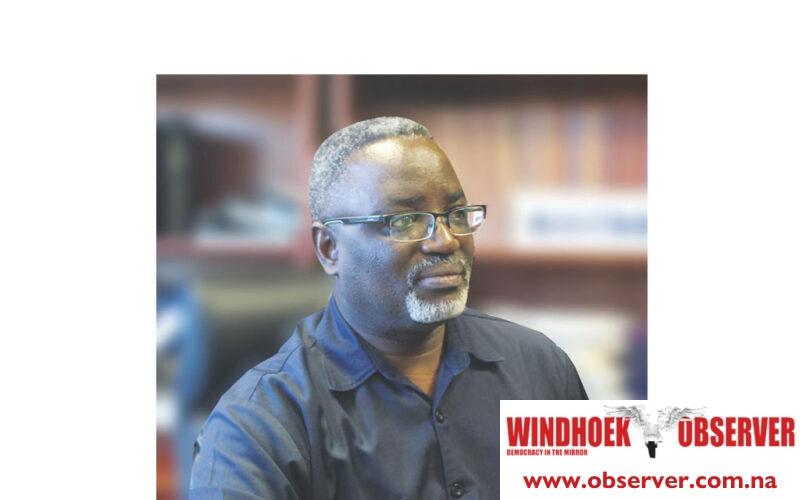
Paul T. Shipale (with inputs by Folito Nghitongovali Diawara Gaspar)
Landless People’s Movement (LPM) leader Bernadus Swartbooi said the government should explore exporting labour by sending qualified Namibians abroad and receiving remittances that can be ploughed back into society.
This follows his concerns that the government is overemphasising social protection and particularly education, the highest-funded sector with a budget allocation of N$28 billion this financial year, which could create more problems.
Swartbooi made the remarks while contributing to a discussion on the national budget in the National Assembly.
“The government needs to look at countries like Nigeria and South Africa, which have agreements with the European Union. Nigeria in particular, because it’s unable to absorb the labour it’s equipping, has exported about 360 000 Nigerian professionals to Greece,” he claimed.
“This resulted in remittances of about US$72 billion (about N$1.15 trillion) to Nigeria. We as a country need to start looking at this. We sit with a pool of about 130 000 qualified, educated, equipped and productive young Namibians who have nowhere else to go,” Swartbooi said and added that exporting labour could be the remedy in addressing unemployment.
From migration to structural reality
Namibia’s education system expanded significantly after independence in 1990, opening access to higher learning without the racial segregation that defined the colonial and apartheid eras. The establishment of the University of Namibia (UNAM) in 1992 marked a decisive institutional shift, and since then, the university has graduated over 70,000 students. A substantial portion of these graduates now form part of the diaspora professionals dispersed across the region and beyond, many of whom continue to look back toward Namibia with the expectation that their skills, experience, and qualifications will one day be meaningfully recognised and integrated into the country’s development trajectory.
This is the starting point that policy discussions often miss: that the diaspora is not incidental. It is the outcome of state investment meeting structural limits at home.
In today’s global economy, diasporas are no longer peripheral communities scattered abroad; they are extensions of national capacity. Countries that understand this have turned their citizens overseas into engines of investment, knowledge transfer, and geopolitical leverage of a workforce that does not effectively subsidise the development of other economies.
In essence, when we say diasporas are now “extensions of national capacity”, the core idea is that a country’s human capital does not stop serving national interests just because it is abroad. In today’s global economy, citizens living overseas can act as channels for investment, skills transfer, and even geopolitical influence, but only if the state has the foresight and systems in place to make that connection effective.
This is where the contrast becomes important.
On one side, there are countries that have recognised this shift and acted deliberately. These states integrate their diaspora into national development strategies. They track skilled nationals abroad, provide incentives for investment, facilitate knowledge circulation, and maintain structured political and economic ties. For them, migration is not a loss but an opportunity, an externalised form of national strength.
On the other side of the spectrum, there are countries that have not built these frameworks. Migration happens in a largely uncoordinated way. Skills leave without being strategically reintegrated, remittances flow but are not leveraged for development, and these states remain disconnected from their citizens abroad. The result is not neutral; such countries effectively subsidise other economies by exporting their most productive capacities without structured returns.
The concern is exactly this and not that labour mobility in itself is harmful but that without a deliberate national strategy, Namibia risks falling into that second pattern or category.
In sum, there are states that treat their diaspora as an organised, strategic extension of national development. The warning is that without such an approach, Namibia risks turning migration into a quiet transfer of national capacity outward, rather than using it as a lever for domestic transformation. In short, the main idea is a strategically governed diaspora and labour export programme, one that treats migration as a national resource rather than a loss. Namibia, at present, risks falling into the latter category of countries that do not develop the framework of integrating their diaspora into national development strategies.
Much has been said about the Namibian diaspora in abstract terms, such as its global presence, its symbolic value, and its potential. But this framing obscures a more immediate and grounded reality: a growing number of Namibians are leaving the country not as diplomats or academics but as skilled workers, disciplined and ambitious, seeking better employment conditions within the Southern African region. This is not incidental migration. It is structural.
Inside the regional economic machine
From the retail floors of Shoprite operations in Angola to managerial and operational roles across South Africa’s corporate landscape, Namibian professionals are embedding themselves in the very systems that drive regional commerce. They are not on the margins; they are inside the machinery managing supply chains, overseeing logistics, training teams, enforcing standards, and sustaining the daily rhythms of large-scale distribution networks.
These are not peripheral roles. They are the backbone of modern economies. Yet their contribution is being captured elsewhere. The uncomfortable reality is that Namibia is exporting not just labour but operational intelligence, the kind of practical, system-level expertise that cannot be easily replicated through formal education alone. This is acquired through immersion in complex organisational environments, through responsibility, repetition, and exposure to scale. In effect, Namibia is allowing other economies, particularly South Africa’s corporate ecosystem and Angola’s expanding retail sector, to absorb and benefit from its human capital.
This is not simply a missed opportunity. It is a structural leakage.
A diaspora seeking engagement, not distance
What makes this situation more striking is that this diaspora is not disengaged. On the contrary, many of these professionals are actively seeking connection with their country of origin. There are increasing calls from Namibians working abroad, particularly those in mid- to high-level management for structured engagement with state institutions, including direct dialogue with political leadership. Some explicitly argue that such engagement could serve as a bridge to attract investment and build confidence among regional and international investors.
This is a critical signal.
It reveals an awareness among diaspora professionals that investment is not driven by market fundamentals alone. It is shaped by political confidence, state signalling, and networks of trust. These individuals are not merely seeking recognition; they are positioning themselves as intermediary actors capable of linking Namibia to capital, systems, and opportunities that remain otherwise out of reach.
The question is not whether this potential exists. The question is why it remains unorganised.
The cost of political inaction
There is currently no coherent national strategy to map, engage, or leverage this labour diaspora. No institutional mechanism to track where Namibian professionals are working, in what sectors, and at what levels of responsibility. No structured platforms for knowledge transfer. No targeted incentives for diaspora-led investment. No formal channels through which these professionals can contribute to national development without necessarily returning home.
This absence is not administrative. It is political.
Because the consequences are cumulative and predictable. When a country fails to engage its diaspora, it does not remain neutral. It enables a silent transfer of value outward:
• Skills are refined within foreign systems
• Productivity strengthens external economies
• Entrepreneurial capacity is realised elsewhere
• Strategic networks are built beyond national reach
Over time, this erodes domestic capacity not through sudden loss, but through gradual displacement.
Lessons from the continent
The contrast with other African countries is instructive. Rwanda has systematically mobilized its diaspora for skills transfer and state building, embedding returnees within key institutions. Ethiopia has leveraged diaspora capital, despite political volatility to support industrial and infrastructure development. Nigeria, with all its internal contradictions, has nonetheless built powerful transnational business networks through its expatriates, particularly in finance, technology, and entertainment.
These examples are not perfect models. But they demonstrate a shared principle, diaspora engagement does not happen organically. It is engineered.
Namibia, by comparison, remains passive. And yet, the necessary foundations already exist.
From potential to strategy
Namibian professionals working across Angola, South Africa, and beyond represent more than individual success stories. They form a dispersed but highly functional ecosystem of experience, discipline, and market exposure. With a coherent policy framework, this ecosystem could be activated to:
• Modernise domestic retail and logistics systems
• Support the regional expansion of Namibian enterprises
• Transfer operational knowledge into local industries
• Mentor and train emerging professionals
• Anchor new ventures upon return or through hybrid engagement models
But none of this will occur spontaneously.
It requires deliberate state action beginning with something deceptively simple but politically significant: recognition.
A Vote of Confidence or a Strategic Failure
Namibia stands at a quiet but decisive juncture. The question is no longer whether the country possesses talent. It clearly does. The question is whether the state is willing to organise that talent beyond its borders.
A meaningful response would go beyond rhetoric. It would involve creating formal diaspora registries, establishing high-level engagement platforms, embedding diaspora expertise within national development planning, and signalling clearly and consistently that external experience is not peripheral to the nation but central to its future. Anything less is not neutrality. It is a choice.
In practical terms, we do agree with Swartbooi that the Namibian labour workforce can and will be exported, because this is an economic reality and can create opportunities for citizens abroad. But the position is not simply to “export labour” without conditions. It is about managing and guiding labour mobility strategically.
This requires regulation, registration, and formal recognition of these workers so the state can track their skills and sectors by ensuring their work abroad benefits Namibia through remittances, knowledge transfer, or investment and prevent unstructured labour migration that ends up subsidising other economies.
In short, the main idea is a strategically governed diaspora and labour export programme, one that treats migration as a national resource rather than a loss. Labour can be exported, but only within a framework that safeguards Namibia’s long-term development interests.
A country that fails to engage its diaspora is not simply overlooking an opportunity; it is actively reinforcing the strength of other economies at its own expense. And that is a choice with consequences.
Disclaimer: The opinions expressed here do not necessarily reflect those of our employers or this newspaper. They represent our personal views as citizens and pan-Africanists.