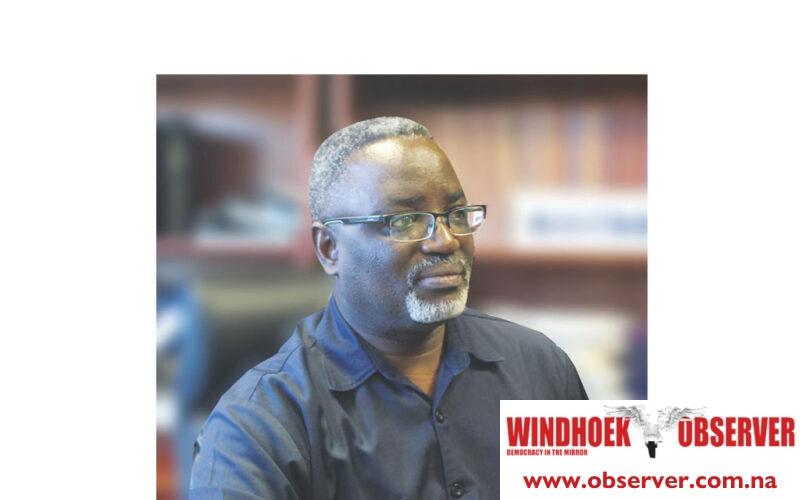
Paul T. Shipale (with inputs by Folito Nghitongovali Diawara Gaspar)
Protecting Justice Without Redesigning Power: A Reflection on Judicial Security, Executive Incentives, and Constitutional Balance the tragic death of Prosecutor Justine Shiweda is a national wound.
She was a regional control prosecutor at the Ondangwa Magistrate’s Court, a senior prosecutorial position indicating that she likely managed a significant caseload while supervising other prosecutors. She indeed stood at the front line of criminal accountability. No magistrate. No prosecutor.
No judicial officer should face mortal danger for fulfilling a constitutional duty. In this regard, both the president and the chief justice said clearly that our judiciary needs security and protection. At Shiweda’s funeral, Chief Justice Peter Shivute said attacks on officers of the court threaten the constitutional order. “When an officer of the court is harmed while carrying out lawful duties, it is not merely an attack on an individual; it is an attack on the system of justice that protects us all,” he said. President Nandi-Ndaitwah also addressed the issue, stating that “no officer of the court should be required to discharge their duties under fear, intimidation or threat”. In addition, Minister Immanuel is correct: protecting those who deliver justice is essential for maintaining public trust and safeguarding the integrity of our institutions. On that principle, there is no disagreement.
When officers of the court are threatened, justice itself is threatened. But beyond the tragedy lies a question that cannot be ignored. It looks like the tragic death of Prosecutor Justine Shiweda was ordered. The modus operandi of criminal networks operating from behind bars is not unknown to law enforcement.
If the operational patterns of such networks are known, why could prevention not occur? The answer may be simple or it may be uncomfortable. What is increasingly clear is that the sentence pronounced in a courtroom may have triggered a counter sentence issued from behind prison walls. That reality demands seriousness, not only emotion.
Protection is essential, but structure matters.
The editorial of the Windhoek Observer is correct to insist that the state carries a duty of care toward those who uphold the law. Where risk is real and credible, protection is not a favour. It is an obligation. We also concur with the editorial when it said security for magistrates and prosecutors must not be treated as a discretionary favour, a reactive gesture, or an ad hoc arrangement triggered by tragedy. It must be institutionalised and codified. Budgeted for. Indeed, the protection of judicial officers must form part of a coherent, system-wide security doctrine, not a patchwork of temporary fixes.
The question, however, is not whether protection is justified. It is how protection should be structured and whether institutionalising blanket, permanent residential security for all magistrates and prosecutors is proportionate to Namibia’s objective security environment. Protection is essential. But proportionality is constitutional.
Namibia’s context matters
Public policy must be grounded in evidence, not emotion. Namibia is not classified as a high-intensity criminal jurisdiction. It is not a conflict zone. It is not a narco-state. It is not a country defined by systematic judicial assassinations.
Crime exists as it does in every society, but Namibia remains comparatively stable within the region.
If credible intelligence demonstrates targeted threats in specific regions such as Ondangwa or Grootfontein, then protection in those areas should be immediate and robust.
But blanket, permanent, 24-hour residential security for approximately 400 magistrates and prosecutors represents a structural transformation of state security architecture. That requires careful scrutiny.
The arithmetic of institutionalisation
Institutionalised 24-hour residential protection implies the following:
• Dedicated vehicles
• Assigned drivers
• Multiple bodyguards per shift
• Rotational relief teams
• Administrative oversight structures
• Pensionable, long-term staffing commitments
• Fuel, logistics, and operational budgets
Conservatively calculated, such a system could require between 2 000 and 3 000 additional personnel.
That is not a temporary response. That is a permanent state expansion.
In a resource-constrained environment, every structural expansion competes directly with the following:
• Healthcare delivery
• School staffing
• Youth employment
• Infrastructure development
Budgeting is not merely technical. It reflects moral prioritisation expressed numerically.
To institutionalise protection without calibrated threat assessment is to embed a permanent fiscal architecture in response to a singular albeit tragic event.
Independence requires careful architecture
The editorial asserts the following:
“Without security, there can be no independence.”
Security can support independence. But architecture can also shape incentives.
When protection becomes a universal entitlement funded and structured through executive-controlled budgets, a subtle administrative interdependence emerges.
No corruption is required.
No bad faith is necessary. Institutional proximity alone influences instinct.
Over time:
• Material ecosystems shape institutional culture.
• Comfort reduces confrontation.
• Stability narrows friction.
This is not cynicism. It is governance sociology.
The separation of powers is preserved not only by constitutional text but also by calibrated distance.
Independence protects judicial decision-making from pressure. Insulation risks distancing judicial officers from the society they serve. In smaller democracies, especially, visible proximity sustains public trust.
Justice must not appear elevated into a permanently securitised class detached from ordinary civic life.
Institutional parity vs institutional permanence
The editorial rightly highlights disparities between judges and magistrates. Parity in protection criteria is reasonable.
Magistrates’ courts are indeed the face of justice for most citizens. But parity does not require maximalism.
In democracies such as the following:
• United Kingdom
• Canada
• South Africa
Judicial protection is typically the following:
• Triggered by verified threat assessments
• Proportionate to documented risk
• Periodically reviewed
• Not institutionalised as a universal entitlement in stable jurisdictions
Security is calibrated.
If threat assessments justify protection in Ondangwa or elsewhere, those protections should be immediate and decisive.
However, converting risk-based protection into permanent residential security for an entire class of officials embeds a protected tier within a jurisdiction not categorised as high risk.
That is a structural decision, not merely a security adjustment.
The deeper question behind the tragedy
The public conversation must also confront a harder issue.
If criminal networks are capable of issuing retaliatory orders from prison cells and if their communication patterns are known, then strengthening prison intelligence, internal controls, and investigative capacity may be more effective than expanding residential escorts nationwide.
The solution may lie less in guarding homes and more in neutralising operational command structures inside correctional facilities.
If the “sentence” against a prosecutor originates from behind bars, then institutional focus must follow the origin of the threat. Protection at the perimeter is important. But prevention at the source is decisive.
A responsible middle path
The choice is not between vulnerability and excess.
A constitutionally balanced framework could include the following:
1. An independent judicial threat assessment unit.
2. Protection triggered strictly by verified, documented risk.
3. Immediate deployment in high-threat zones.
4. Strengthened prison intelligence and communication monitoring.
5. Periodic review of ongoing necessity.
6. Transparent reporting to Parliament on cost and criteria.
Such a model would:
• Protect judicial officers effectively
• Preserve constitutional separation
• Safeguard public finances
• Maintain public trust
Protection and proportionality are not opposites. They are partners.
Conclusion: Protect Justice But Protect It Wisely
The death of Justine Shiweda must not fade into bureaucratic inertia. Judicial officers must be safe. That principle is beyond dispute.
But safety must be
• Evidence-based
• Proportionate
• Institutionally neutral
• Periodically reviewed
Democracies rarely weaken through dramatic collapse.
They evolve through incentives, structures, and normalised privilege. If security becomes a status, and status becomes structural, then influence becomes architectural. Architecture, over time, redesigns power. In safeguarding magistrates and prosecutors, let us also safeguard equilibrium.
Justice must remain protected but never so elevated that it drifts from the society it exists to serve.
Disclaimer: The opinions expressed here do not necessarily reflect those of our employers or this newspaper. They are solely our personal views as citizens and pan-Africanists.