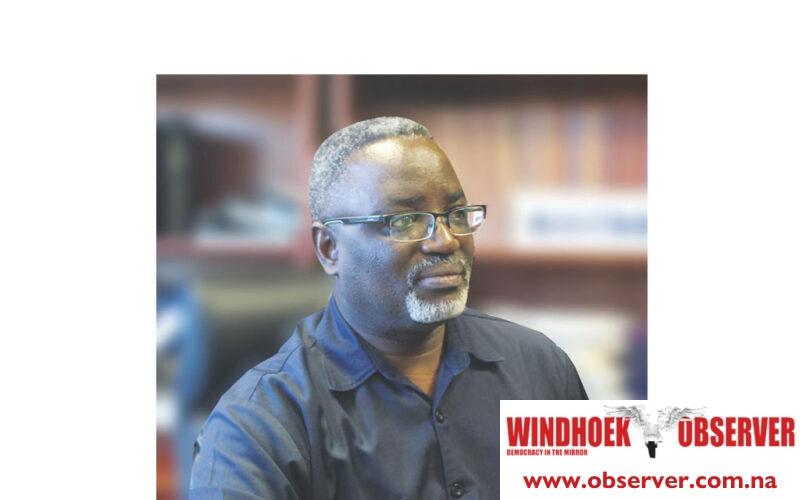
Paul T. Shipale (with inputs by Folito Nghitongovali Diawara Gaspar)
A crisis not of power, but of thought. After the thought-provoking editorial penned down by the Windhoek Observer on the occasion of the 66th anniversary of Swapo, one could not help but admire the accuracy of the analysis, especially when it refers to a drift and a loss of intellectual compass, ideological clarity, and, perhaps most dangerously, its sense of purpose, said the editorial.
Indeed, for a party that once embodied ideological clarity, rooted in anti-colonial struggle, social justice, and a defined vision of economic transformation, it now appears ideologically adrift. It really seems that somewhere between being a liberation movement and a governing party, Swapo has lost the plot, as it is no longer the revolutionary vanguard it once was but not quite a modern, policy-driven political party either.
The consequences of this drift are not theoretical, but they are playing out in real time. Suffice it to look no further than the fragmentation of the political landscape where virtually every significant opposition force today is a splinter of Swapo’s own making, such as the Independent Patriots for Change, the Affirmative Repositioning, and the Landless People’s Movement, which are not born in ideological opposition but in internal contradictions that have broken away.
That should alarm anyone who cares about the health of Namibia’s democracy, said the editorial, and one should add here, anyone who cares about the party of the Nujomas, Ya Toivo, Moses Garoeb and many others, because when a ruling party begins to haemorrhage its own thinkers, its own activists, and its own ideological energy, what remains is often a hollow shell, held together not by ideas, but by inertia and patronage. Namibia’s current political moment is widely interpreted through the lens of electoral resilience. Swapo remains dominant. The state is stable. Opposition forces, while growing, have not displaced the ruling party.
But this reading is superficial. The deeper crisis is not electoral. It is intellectual. Political parties rarely decline because they lose power first.
They decline because they lose the capacity to produce ideas or coherent frameworks that connect historical identity to present realities and future strategy. When that happens, governance continues, but direction dissolves. That dissolution is now visible in Namibia.
The gap between political language and material reality is widening. Policy announcements accumulate, yet they fail to cohere into a recognisable national project. Economic outcomes contradict stated ambitions. Strategic decisions appear episodic rather than anchored in doctrine. This is not a communication problem. It is a failure of political thought and its consequences are structural.
From ideological clarity to conceptual drift
Swapo was never merely an administrative entity. It was a liberation movement forged in anti-colonial struggle, grounded in a clear ideological posture against imperial domination and for national unity. That clarity was embodied in the vision of the founding father, H.E. Dr Sam Nujoma and crystallised in the motto of solidarity, freedom and justice as well as in the principle of “One Namibia, One Nation”.
That ideological coherence performed a historic function that mobilised, unified, and legitimised.
But liberation ideology is not self-executing in a post-independence state. It must be translated into a developmental doctrine, one that defines the following:
• how resources are governed
• how industrialisation is pursued
• how sovereignty is exercised in a global system
That translation has been partial at best. Instead, Namibia has entered a phase of conceptual drift:
• Liberation ideology is preserved symbolically but not operationalised
• Historical legitimacy is invoked but not strategically updated
• Policy adapts pragmatically but without an overarching framework
This is not ideological evolution. It is ideological evaporation.
Intellectual stagnation as the core constraint
At 66, Swapo faces a fundamental limitation, and it no longer produces ideas adequate to governing a complex, post-liberation economy. This stagnation is not abstract, but it manifests in concrete policy contradictions.
1. No coherent economic doctrine
Namibia continues to rely heavily on extractive industries, particularly mining, yet lacks a clearly articulated beneficiation strategy. Resource extraction proceeds without a codified national framework ensuring value addition, technological transfer, or industrial deepening. The result is growth without transformation.
2. Strategic ambiguity in global engagement
Namibia engages multiple international partners across a shifting global order. But engagement is not the same as strategy. There is no clearly defined national doctrine guiding how partnerships translate into leverage, industrial capacity, or economic sovereignty. In practice, this risks reproducing dependency only with diversified partners.
3. Reactive rather than directive politics
Swapo increasingly responds to opposition narratives rather than setting the national agenda. This is not tactical flexibility; it signals a loss of intellectual initiative. A governing party that reacts rather than defines is already ceding ideological ground.
When critique becomes diagnosis
The growing clarity of opposition critiques is not incidental, but it is symptomatic. When figures like Evalistus Kaaronda of Swanu articulate contradictions that the ruling party itself has not resolved, most notably the tension between Swapo’s anti-imperial origins and aspects of its contemporary diplomatic posture, as we have witnessed during the SONA in front of the entire nation and members of the diplomatic corps, that shows a serious drift.
This is not a question of ideological purity. It is a question of continuity. How does a movement historically defined by resistance to external domination justify policy positions that appear, at times, structurally accommodating to global power asymmetries?
Swapo has not provided a coherent answer. And in politics, what remains undefined is defined by others.
Material consequences of intellectual drift
The intellectual crisis is not theoretical; it is visible in Namibia’s economic structure:
• Persistent reliance on extractive sectors with limited downstream industrialisation
• High youth unemployment, reflecting a disconnect between growth and inclusion
• Land reform framed politically but lacking a viable economic model
• Urban and peri-urban marginalisation and unequal access to opportunity
These are not new challenges. What is new is the absence of a unifying framework through which they are addressed. Policies exist. Initiatives are launched. But they do not accumulate into a coherent developmental trajectory.
This is what intellectual stagnation looks like in practice: not inactivity, but fragmentation of purpose.
Symbolism without structural transformation
The rise of the current President, Netumbo Nandi-Ndaitwah, as Namibia’s first female president marked a historic milestone. Its symbolic significance is undeniable.
But symbolism operates within political systems, and it does not substitute for them. In the absence of ideological clarity, symbolic breakthroughs risk stabilising legitimacy without resolving underlying structural constraints.
Representation matters. But without a defined national project, it cannot drive transformation. The central question remains: toward what strategic end is political power exercised?
Fragmentation as internal evidence
The emergence of new political formations is often celebrated as democratic pluralism. That reading is incomplete.
Movements such as:
• Independent Patriots for Change
• Affirmative Repositioning
• Landless People’s Movement
They are not external disruptions. They are internal derivatives of unresolved contradictions within SWAPO itself.
Each reflects a specific fault line:
• land redistribution and historical redress
• generational exclusion from power and opportunity
• urban inequality and economic marginalisation
Taken together, they form a shadow ideological map of Swapo’s own limitations. Fragmentation, in this sense, is not merely competition. It is structural evidence of a party that can no longer absorb and resolve its own tensions.
Global positioning without doctrine
As Luiz Inácio Lula da Silva has argued, the global system remains defined by asymmetry, not fairness. Multipolarity expands options but only for states capable of strategic coherence.
Without a clear national doctrine, Namibia risks:
• diversifying partners without increasing bargaining power
• engaging diplomatically without securing structural gains
• reproducing dependency under new alignments
The issue is not engagement. It is the absence of a framework defining the terms of engagement.
The unfinished transition
Liberation movements are designed for struggle. They mobilise through resistance and unify through opposition.
Governance requires something fundamentally different:
• policy precision
• institutional discipline
• continuous intellectual renewal
Swapo appears suspended between these two logics. Its continued reliance on liberation-era framing suggests an incomplete transition into a governing party capable of producing forward-looking ideas.
This is not rhetorical inertia. It is a structural constraint.
What renewal would require
If the crisis is intellectual, the response must also be intellectually grounded in doctrine and ideologically sound in the foundational principles, not slogans and sloganeering.
At minimum, renewal would require:
• A clearly defined economic model, specifying the role of the state in industrialisation and resource governance
• A national beneficiation strategy linking extraction to domestic value chains
• A foreign policy doctrine anchored in economic sovereignty rather than diplomatic flexibility alone
• Internal party reform to restore ideological production as a central function of political leadership
Without these, adaptation will remain reactive and fragmented.
Conclusion: The danger of governing without understanding
Swapo’s historical role in Namibia’s liberation is secure. That legacy is not in question.
What is in question is whether the party still functions as an intellectual engine capable of interpreting reality and shaping the future.
The most dangerous phase in the life of a dominant party is not when it loses elections.
It is when it loses the ability to think and to produce ideas adequate to the conditions it governs and to align its actions with a coherent long-term project.
At that point, decline is not immediate. Power persists.
But governance becomes mechanical, detached from understanding.
That is the trajectory that Namibia risks, not a conventional political crisis, but something more subtle and more consequential, a governing party drifting away from its own ideological foundations and, in doing so, losing the capacity to recognise the scale of its own transformation.
And when a party no longer understands itself, it risks not meaningfully directing a nation and that would be a tragedy for this country.
Disclaimer: The opinions expressed here do not necessarily reflect those of our employers or this newspaper. They represent our personal views as citizens and pan-Africanists.