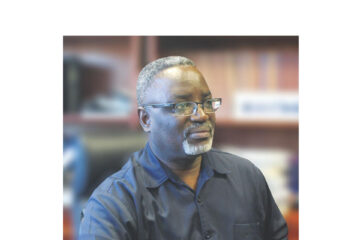

Recently, I received a visit from a Nigerian colleague who had travelled to Namibia to consult on nationhood branding.
As we walked through Windhoek’s central district, he stopped abruptly, surveyed the cityscape, and asked with visible confusion, “Where are your cultural markers?” A few minutes later, after observing more concrete, glass, and corporate branding than any trace of Namibian cultural presence, he looked at me and said, “You guys are so culturally cautious that you are killing your identity.” His remark, although delivered lightly, struck me with unexpected force. It was embarrassing, not only because he was right, but because his observation highlighted something many Namibians have quietly normalized: the near absence of cultural self-expression in our own public spaces.
The argument that Namibia suffers from a cultural void is no longer hyperbole; it has become a lived reality. Our country does not lack creative minds, what it lacks are custodians capable of translating artistic potential into national heritage. The absence of artistically defining markers, be they public sculptures, celebrated literary figures, or institutionally protected archives, reveals a deeper structural failure. As Léopold Sédar Senghor once insisted, “Culture is the beginning and the end of all things human.” When a nation weakens its cultural foundations, it weakens its very sense of self. Namibia today stands at such a precipice.
One of the most striking symptoms of Namibia’s custodial crisis is the absence of physical art in our public spaces. Our towns and cities lack sculptures that speak to our past, present, or future. There is no monumental celebration of anti-colonial heroes, no abstract works reflecting indigenous philosophies, no visual narrative of collective memory. In societies where culture is deliberately nurtured, public sculpture is not decorative, it is pedagogical. Berlin’s memorials, Dakar’s Renaissance Monument, and Nairobi’s public installations form part of an everyday dialogue between citizens and national identity. These symbols become anchors, reminders that a people’s history and imagination remain alive.
Namibia, however, offers little such dialogue. Our urban landscapes are dominated by commercial signage rather than cultural consciousness. As Achille Mbembe warns, “A society that does not produce its own symbols risks becoming a prisoner of those produced by others.” Without public art, Namibia risks cultural anonymity, becoming a nation that cannot visually recognize itself.
Namibia is also one of the few countries on the continent without a Poet Laureate, or even a nationally recognized mechanism for elevating poets. Poetry, in many societies, serves as a nation’s emotional and intellectual archive. Ireland’s Seamus Heaney, South Africa’s Mongane Wally Serote, and Senegal’s Senghor were not merely writers; they were cultural interpreters and national voices. Namibia, by contrast, has neither an official literary custodian nor the institutional structures necessary to sustain one.
A telling anecdote underscores this void: when then South African President Thabo Mbeki visited Namibia, he reportedly sought an anthology of Namibian poetry to quote during a state dinner. Unable to locate a comprehensive national collection, he turned to the work of Mvula ya Nangolo, who, by all accounts, should already occupy the position of Namibia’s Poet Laureate. Mbeki’s gesture was not incidental. Throughout his presidency, he incorporated arts and culture as a cornerstone of his political philosophy, ensuring that cultural expression remained firmly in the public imagination. He understood, more clearly than many leaders on the continent, that a nation must continually narrate itself if it wishes to endure.
When, then, did a Namibian poem last anchor a public ceremony, a political speech, or a school curriculum? The absence of visible poetic voices is symptomatic of a nation that has not invested in its cultural memory. As Ben Okri reminds us, “A people are as healthy and confident as the stories they tell themselves.” Namibia’s stories remain scattered, unarchived, and unsupported.
This custodial vacuum becomes even more glaring when one considers figures such as the late John Muafangejo, arguably one of Namibia’s greatest visual artists. Internationally respected for his evocative linocuts, Muafangejo should occupy the same symbolic space in Namibia that Gerard Sekoto holds in South Africa or Malangatana holds in Mozambique. Yet one rarely encounters Muafangejo’s work in government buildings, corporate boardrooms, or educational institutions. His absence in national spaces is not merely an omission, it is evidence of a state apparatus that has failed to institutionalize its artistic heritage.
The failure to enshrine Muafangejo’s legacy is not an isolated oversight; it reflects a broader pattern of neglect. Without state-supported national collections, without museum acquisition budgets, without cultural policies that prioritize preservation, Namibia continues to lose the opportunity to anchor its identity in the achievements of its own artists. To paraphrase Goethe, “A nation that does not honor its geniuses is one that has not yet understood itself.”
Namibia’s crisis stands in stark contrast to both African and European commitments to cultural custodianship. South Africa, despite its political and economic complexities, has preserved a vibrant artistic ecosystem supported by museums, galleries, funding bodies, and legislative frameworks. Senegal, under Senghor, understood culture as the soul of national development. Burkina Faso hosts FESPACO, the continent’s largest and oldest film festival, a testament to political will in cultural matters. Across Europe, governments treat culture not as an afterthought but as an essential public good. France invests billions annually in the arts; Germany supports hundreds of theatres and museums through public funding; and Scandinavian countries integrate arts education into early schooling. These societies understand that cultural infrastructure requires continuous care, strategic funding, and policy continuity.
To insist that Namibia is creatively barren is demonstrably untrue. Creativity thrives in our communities, in informal art markets, in emerging fashion and digital media spaces, in music, dance, spoken word, and craft. But creativity alone cannot produce a national culture. As Ngũgĩ wa Thiong’o notes, “Culture is a product of history, but it must also be carefully cultivated to guide history.”What Namibia lacks is cultivation—systems of preservation, elevation, and continuity.
Arts councils remain underfunded. Public schools rarely prioritize arts education. Corporate Namibia channels more resources into sports sponsorships than artistic development. Government cultural institutions operate with limited resources and insufficient strategic vision. The result is a nation overflowing with creativity but starving for custodianship.
The Government’s Central Role
Namibia’s government cannot escape its role as the primary custodian of national culture. The current administration’s inclusion of the performance industry in its developmental vision is laudable, but vision without implementation is merely rhetoric. Many initiatives, establishing a Poet Laureate program, commissioning public sculptures, expanding museum capacities, or instituting national arts funding, are feasible even within modest budgets. What is required is not extravagant expenditure but political will.
Namibia stands at a crucial crossroads. Without deliberate cultural custodianship, the nation risks becoming, in Fanon’s words, “a society with a mutilated identity.” Yet the potential for cultural renewal remains immense. The creativity is here; the voices are here; the stories are here. What is missing is the commitment to enshrine them into national identity. The survival, and revival, of Namibian arts begins and ends with custodianship. And custodianship begins and ends with government.