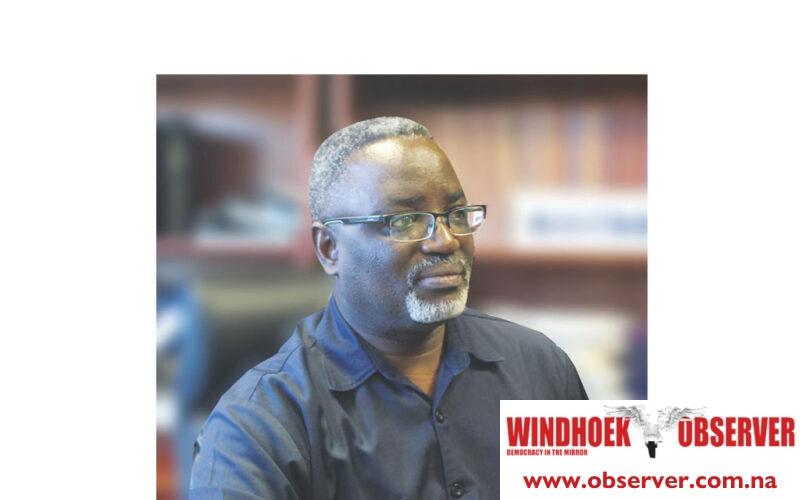
PAUL T. SHIPALE (with inputs by Folito Nghitongovali Diawara)
Namibia is widely praised for its stability, democratic institutions, and robust legal frameworks. Yet beneath this reputation, a troubling pattern has emerged: accountability is increasingly inconsistent, seemingly influenced more by political proximity than principle.
From diplomatic postings to internal reshuffles, some officials face swift public censure, while others with comparable controversies are quietly elevated. This uneven application of rules raises concerns that Namibia may be drifting toward selective governance, a phenomenon observable in other African democracies under political strain.
Let us unpack these contradictions, trace their origins, and examine what they reveal about the state of institutional fairness in Namibia today.
(See: African Governance Barometer 2023; Afrobarometer Round 9 Namibia Report.)
First case study – The curious case of Mac Hengari
Mac Hengari’s dismissal was publicly framed as a principled stand against misconduct, but if such misconduct warrants disqualification, why did others’ misconduct and accountability culminate in a diplomatic posting? This inconsistency raises serious questions about fairness. Indeed, in contrast, former Governor Ndevashiya, whose public service record has faced scrutiny, was appointed to one of Namibia’s most strategic missions in Nigeria.
The divergent treatment prompts a stark question: Is Namibia applying “deux poids, deux mesures”—two weights, two measures, or what we call double standards—in governance? If controversy disqualifies one official, why does another with comparable issues receive promotion? The answer appears rooted in selective enforcement rather than merit-based judgement.
The deafening silence on the founding father’s office speaks volume
Nearly a year after the passing of the Founding Father, administrative clarity regarding his office remains unresolved. Meanwhile, politically connected individuals, especially those who served under the sixth and seventh administrations, were reassigned or protected swiftly, even receiving their salaries up until December 2025.
The contrast between stagnation in one area and rapid redeployment elsewhere deepens public uncertainty, particularly regarding the official status of the Office of the Founding Father and First President of our Republic. Here, silence has become its own statement and speaks volumes.
Are perpetual appointments meant to appease internal factions or reward loyalty?
Across ministries, state-owned entities, and foreign missions, a small circle maintains influence regardless of past controversies:
Some newly appointed ambassadors already served many years as ambassadors and are now promoted to serve again.
• Others were repeatedly appointed.
• Political-business networks: insiders retain fishing quotas and advisory roles in state-linked institutions.
These patterns reflect structural continuity in elite privilege. An African proverb warns:
“The beetle says, “I am not the only one who should be seen.”
Yet in Namibia’s public sector, visibility and accountability should entail and appease factions in a selective fashion.
Current trends suggest the possible return of familiar figures. Their re-entry will be less about merit and more about loyalty.
In political chess, predictable moves still carry consequences: checkmate – échec et mat.
The passing of Founding President Sam Nujoma marked more than the end of an era and a life; it revealed, with stark clarity, the widening fault lines of the return of identity and tribal politics coupled with favouritism. Indeed, a struggle long simmering beneath the surface has become impossible to ignore: the tension between constitutional discipline and the seductive shortcuts of political convenience.
Now the question facing the country is profound: will unity remain genuine, rooted in principle, or will it become a performance staged for public consumption while internal divisions fester?
A legacy at risk: Division masquerading as strategy
Namibia’s history is etched with the scars of tribal division, a wound that Founding President Sam Nujoma sought to heal in building a nation. He warned that strength lay not in slogans but in disciplined collective action. Today, however, whispers of favouritism, procedural shortcuts, and political manipulation threaten to reduce this hard-won unity to a stage performance.
When political loyalty replaces principle, unity cannot survive as a show while internal factions quietly fracture the country from within.
The quiet erosion of authority
Hypocrisy is not diplomacy; it is the slow, corrosive erosion of moral authority. Within the country’s leadership, some now cloak internal manipulation in the language of pragmatism, presenting fear, favouritism, and division as clever leadership. This is not a protest against the system itself; it is a call to confront the hypocrisy within the elite who, from time to time, commodify the popular will. These forces threaten to reduce the country’s cohesion and unity to a staged performance, masking deep internal fractures with the illusion of cohesion.
Leadership built on distrust, manipulation of the system and using identity and tribal politics is no leadership at all. Those who exploit identity fractures and internal fear are not serving the nation; they are weaponising it. True leadership begins with integrity, even in the smallest communities, and it is measured not by appearances but by consistency, transparency, and adherence to principle.
Lessons ignored at Peril
The liberation of Namibia was hard-won, whether in Angola, Zambia, Congo, Cuba, or at home. These memories are not nostalgia; they are reminders that:
• Leadership is earned, not seized.
• Unity is essential, not ornamental.
• The Republic was built on principle, not political theatre.
To forget this legacy is to risk reducing Namibia’s revolutionary history to a mere backdrop for opportunistic power plays. Money and fame cannot replace nor buy a genuine cause of the masses for which many sacrificed their lives! The moment we allow money politics to take over the real cause, then any wind can come and buy us off! Very soon we will have the names of those who just buy and rent luxury apartments in the richest suburbs in Windhoek such as Ludwigsdorf, known for embassies and high property values; Luxury Hill, an established affluent area with historic castles; Klein Windhoek, which is also very affluent and popular with business executives while other wealthy areas and luxury estates are Olympia, Kleine Kuppe, and estates like Am Weinberg Estate, offering high-end living with security and scenic views while the names of Moses Garoeb, Tobias Hainyeko, Maxton Mutongolume, Peter Mweshihange, Peter Nanyemba, Andimba Toivo ya Toivo, Nathanael Maxuilili, Brendon Simbwaye, David Meroro, Ben Amathila, John ya Otto, John Nankudhu and many others, including our mothers and fathers in the villages who truly sustained our liberation struggle, will feature nowhere except maybe at Heroes Acre since what will talk will be the billions one owns in the bank and depending on how many fish quotas and oil deals as well as how many time they travel to Dubai or Qatar.
The drops of sweat and tears of the real struggling people, which fill this land of the brave, and their blood, which waters our freedom, will long be forgotten unless we all affirm that it is not on our watch!
Principle vs. convenience.
With the current power struggles, key questions arise:
• Will the constitution be respected or bent to justify expediency?
• Will principled dissent be treated as a threat or as the moral compass and barometer?
Many voices of wisdom cautioned that bending the rules for short-term gain destroys long-term trust. Yet today, principled voices are recast as enemies, and internal dissent is punished, while the language of convenience dominates. This is the quiet crisis of credibility and legitimacy: we risk undermining the very foundation the country was built upon. If politicians, academics, bureaucrats, journalists, business leaders, and ordinary citizens cannot stand and speak for truth and justice, then they become complicit in tyranny.
Unity on display: But can it be trusted?
Presentations of ceremonial consolidation behind leadership and public displays of unity cannot conceal internal tensions. Unity that is engineered through shortcuts, fear, or manipulation is not true unity; it is an illusion. If the country’s leadership cannot demonstrate integrity within its own ranks, how can it demand national trust? The credibility of the leadership and the nation’s confidence in it hang in the balance.
Conclusion: A moment of reckoning
Founding President Sam Nujoma’s generation fought to ensure Namibians would be “masters of this vast land.” Today, his words serve as a mirror for the current generation. Will leaders protect the principles that built the nation, or allow convenience and factionalism to hollow them out? Is there truly unity, or is one faction dominating another, and is there a comeback of “ethnic entrepreneurship”? Leadership must be earned through transparency, consistency, and adherence to the rules that bind the nation itself. Power may be inherited, but credibility and legitimacy cannot; they must be fought for every day.
Namibia is at a critical juncture. A democracy cannot function when similar conduct yields punishment for one official and promotion for another.
Selective governance:
• Weakens institutions,
• Rewards allegiance over competence,
• Erodes public trust.
Without consistency, justice becomes theatre, and democracy becomes fragile.
Disclaimer: The opinions expressed here do not necessarily reflect those of our employers or this newspaper but are solely our personal views as citizens and Pan-Africanists.